Posted by Liberty Industries on | Comments Off on The Advantages of Cleanroom Pass-Thrus
Since 1953, Liberty Industries has served as a global manufacturer and distributor of high-quality cleanroom and contamination control supplies and accessories. We offer a broad selection of cleanroom products, ranging from modular, softwall and hardwall cleanrooms to cleanroom components to personnel garments. Regardless of your cleanroom needs, our experienced engineers can design and deliver a custom-tailored solution that meets your specifications.
Cleanrooms are generally used in the manufacture of sensitive components that cannot tolerate contamination—e.g., medical devices, pharmaceuticals, and electronics. These structures provide control over the workspace, maintaining set levels of temperature, humidity, light, air pressure, and other environmental variables. They can also have additional features, such as sealed airlocks and decontamination areas, that facilitate the maintenance of sterile conditions.
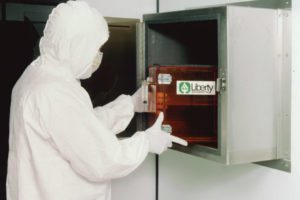
Pass-thrus—also known as pass-thru cabinets, chambers, or windows—are a critical cleanroom component. These two-door structures are typically installed directly into the cleanroom’s walls and, when opened one door at a time, allow objects to pass into or out of the cleanroom while reducing the risk of contaminants.
What Are the Benefits of Pass Thrus for Cleanrooms?
Pass-thrus are an affordable and easy-to-install way to protect the cleanroom environment and meet industry safety standards. In addition to preventing external contaminants from entering the cleanroom, they reduce the number of workers in the room at any given time and limit the frequency of room entries and exits. Both of these things help to further reduce the risk of contamination.
Integrating a pass-thru also means cleanroom personnel do not need to shower and gown up to place or remove materials from the cleanroom. This saves time and, ultimately can increase productivity.
Pass-thrus are durable, easy to clean and maintain. Additionally, they are highly customizable, coming in a range of materials, sizes, and designs to meet different cleanroom needs. For example, they are available with fireproofing for combustible material handling and with HEPA air filters for highly sensitive product manufacturing.
The integration of pass-thrus benefits virtually any industry that requires the use of cleanrooms, including the following:
Aerospace
Computer manufacturing
Electronics and technology
Medical
Military
Pharmaceuticals
Research
Solar power generation
Types of Pass-Thrus Available at Liberty Industries
At Liberty Industries, we offer several pass-thru models for cleanroom construction projects, including:
Stainless steel pass-thru.Also known as a pass-thru window communicator or package transfer unit, this pass-thru system features stainless steel construction, acrylic doors, and stainless steel hinges. Customization options include interlock systems, fireproof doors, and custom sizes.
H-100SS pass-thru with a magnetic lock.This two-door cabinet uses a magnetic interlock system to keep both doors from opening at the same time. It is especially useful for hospital pharmacies and other organizations that require high levels of security.
H-100 PL series laminated pass-thru.This pass-thru chamber is made with high-pressure plastic laminate and has an acrylic door with chrome-plated hinges. It provides maximum protection from contamination while still allowing for the easy transfer of materials. Optional add-ons include a reverse-action interlock.
Motorized HEPA/ULPA-filtered pass-thru.This pass-thru unit has a high-velocity air wash and highly efficient filter. Custom sizes and filtration levels are available, as well as options for stainless steel shelves, laminated novaply, and fireproof doors. Customers can choose from recirculating or non-recirculating models.
Partner With Liberty Industries for Your Cleanroom Needs
Pass-thrus are critical cleanroom components that help keep your cleanroom contaminant-free for sensitive manufacturing operations. With over 65 years of experience designing and constructing cleanrooms, the Liberty Industries team can help you choose the right model and design to suit your cleanroom needs. Our products are also proudly Made in the USA!
For additional information about pass-thrus or to discuss your cleanroom specifications with one of our experts, contact us or request a quote today.
Posted by Liberty Industries on | Comments Off on Positive Air Pressure Cleanrooms vs. Negative Air Pressure Cleanrooms
As a manufacturer and distributor of top-of-the-line cleanrooms and contamination control products, Liberty Industries, Inc. serves as a one-stop shop for all cleanroom needs. Our expert team assists in every aspect of cleanroom creation—from design to construction and assembly—to provide custom-tailored solutions to a wide range of industries. Whether a customer requires a standard or highly specialized area; a positive air pressure cleanroom or negative air pressure cleanroom, we can meet their needs.
Positive Pressure vs. Negative Pressure Cleanrooms: Similarities and Differences
When planning or preparing for a cleanroom installation, one of the most significant design considerations is whether it features a positive air pressure or a negative air pressure configuration. This factor relies heavily on the specifications of the intended application.
Positive Air Pressure Cleanrooms
A positive air pressure cleanroom has an air pressure level that is greater than that of the surrounding environment. This is achieved through the use of an HVAC system, which pumps clean, filtered air into the structure. When the door of the cleanroom is opened or if the cleanroom experiences a structural breach, the pressure disparity forces the clean air out rather than allowing unfiltered, potentially contaminated air in.
Positive air pressure cleanrooms are most commonly used in applications where keeping contaminants—such as dirt or debris—away from the contents of the cleanroom is critical. For example, it can be used to protect immunocompromised patients in hospitals or sensitive products such as microchips during the manufacturing process.
Negative Air Pressure Cleanrooms
In contrast to a positive air pressure cleanroom, a negative air pressure cleanroom maintains an air pressure level that is lower than that of the surrounding room. This condition is achieved through the use of an HVAC system that continuously filters air out of the room, pumping clean air into the room near the floor and sucking it back out near the ceiling.
Negative air pressure cleanrooms are used to keep contaminants contained within the enclosed work environment. If opened or breached, the pressure disparity forces air into the cleanroom, preventing contaminants from escaping. For the room to function properly, all windows and doors must be fully sealed and outtake filters must be installed.
This type of cleanroom commonly finds application in the biochemical, pharmaceutical, or medical industries. Industry professionals use it as an isolation chamber when testing or working with potentially harmful compounds and separating contagious patients to help prevent the spread of illness.
Similarities Between Positive Pressure and Negative Pressure Cleanrooms
Although the functions of positive pressure and negative pressure cleanrooms are quite different, they are some similarities between the two. For example, both types require the use of:
Powerful HEPA filters, which, along with the other HVAC system parts, need careful maintenance
Self-closing doors and properly sealed windows, walls, ceilings, and floors to facilitate the maintenance of appropriate air pressure levels
Multiple air changes per hour to ensure proper air quality and pressure conditions
Ante-rooms for employees to change into the required protective clothing and deliver the necessary materials and equipment
In-line pressure monitoring systems
Leave it to the Experts at Liberty Industries to Design & Construct Your Cleanroom!
Whether you need a positive air pressure or negative air pressure cleanroom, an experienced cleanroom manufacturer and distributor, such as Liberty industries, can ensure the design, development, and delivery of a solution that meets your needs. At Liberty Industries, our experts have full working knowledge of the entire cleanroom design and construction process, from cleanroom materials and best practices to the HVAC equipment needed for different types of applications. We also offer a variety of cleanroom accessories and equipment, including shoe brush machines, Tacky Mats ® and air showers. Our products are also proudly Made in the USA!
No matter what type of cleanroom you need, we’re your one-stop shop to getting the perfect solution. For additional information about our cleanroom capabilities or to discuss your cleanroom specifications with one of our experts, contact us or request a quote today.
Posted by Liberty Industries on | Comments Off on Softwall Cleanrooms vs. Hardwall Cleanrooms
Liberty Industries is a manufacturer and distributor of industry leading modular cleanrooms. These controlled, free-standing environments allow experts in a variety of industries to perform delicate manufacturing, sensitive research, and other processes. Our team has more than 60 years of experience providing cleanrooms and other contamination control supplies.
We serve leading organizations from a wide variety of industries. Some of the industries that we serve include:
Medical equipment manufacturing. Cleanrooms help ensure that delicate, sensitive, and sanitary medical equipment does not become contaminated.
Assembly and packaging. Our cleanrooms are ideal for sterile packaging applications.
Electronics. The electronics industry relies on cleanrooms to ensure component cleanliness during the assembly of sensitive electronic devices. Particulate contamination as minor as a speck of dust on a microchip can compromise a system.
Aerospace. Aerospace manufacturing cleanrooms allow industry experts to deliver safe, effective aerospace components in an industry where even minor mistakes can lead to catastrophic equipment failure.
Research and development. Cleanrooms help ensure that research is accurate and study subjects remain sanitary.
Food preparation and processing. Many food preparation and processing applications require complete sterility. Our cleanrooms allow food manufacturers to achieve this level of sterilization with ease.
Pharmaceutical manufacturing. Creating life-saving medication requires sterile work surfaces with no chance of contamination.
What are the Different Types of Cleanrooms?
The potential uses for cleanrooms are quite varied, so they are available in multiple forms. The key to successful cleanroom implementation lies in selecting the cleanroom best for your individual application. Modular cleanrooms are often an ideal choice because of their versatility and adaptability to changing application needs.
At Liberty, we offer two varieties of modular cleanrooms: softwall and hardwall.
Softwall cleanrooms are built around steel superstructures. Their walls are engineered with visibility and flexibility in mind and typically feature soft, transparent vinyl walls and entrances.
Hardwall cleanrooms rely on prefabricated panels to form the walls and ceilings of the cleanroom. These panels may be constructed out of a number of materials, but most hardwall cleanrooms are acrylic with cabinet-style entrances.
Some features, however, persist in both hard and softwall cleanrooms. Both of these varieties are easy to transport and adapt to a variety of requirements. Custom or specialized elements like filters, furniture, and lighting are available regardless of cleanroom type. Hard and softwall cleanrooms can also both be certified to meet an array of industry standards, including US FED STD 209E and ISO Standard 14644-1.
Softwall Cleanrooms vs. Hardwall Cleanrooms
Softwall Cleanrooms
Softwall cleanrooms present a number of benefits. They are especially ideal for applications that require:
Easy installation and deconstruction. Softwall cleanrooms are simple to install and remove thanks to their flexible design. They also do not require underground preparations.
Emergency or short-term use. Softwall cleanrooms are not as ideal for ultra-sanitary applications as hardwall cleanrooms. They’re ideal for applications with less critical processes or as holdovers during other projects.
Flexibility and customization. Modifying these structures in order to put them into virtually any environment is always an option. Even though the structures are made of steel, they can be fitted to a wide variety of heights and widths.
Minimal cleanroom footprint. Softwall cleanrooms offer an ideal solution for facilities with limited available space.
Cost-effective. Due to the short installation process, softwall cleanrooms tend to be more affordable than their hardwall counterparts.
Hardwall Cleanrooms
Unlike softwall cleanrooms, the rigid structure of hardwall cleanrooms renders them more suitable for projects that require:
Stable structure. If a stable structure is required to protect people or products, a hardwall cleanroom will prove far more beneficial than a softwall alternative.
Permanent or semi-permanent use. Hardwall cleanrooms are built with permanent infrastructure, so they’re best suited to applications that can utilize them on a permanent or semi-permanent basis.
Pressure regulation. The harder wall panels make it easier to keep pressure regulated within the contained environment.
Prevention of airborne contaminants. Temporary structures are more prone to leaks or punctures that can contaminate the cleanroom. Permanent structures largely mitigate this risk.
Privacy and security. Hardwall cleanrooms are easier to secure and also contain sound better than softwall cleanrooms. This is ideal for applications where sensitive or classified research may be conducted.
Hardwall and Softwall Cleanrooms From Liberty Industries
At Liberty Industries, we’re proud to offer our clients an expansive range of cleanroom solutions and related products. Our product line includes:
Softwall and hardwall modular cleanrooms. We offer cleanrooms suitable for use in a variety of applications that are easily customizable to suit a wide range of requirements.
We offer a complete line of cleanroom furniture in order to ensure sterility and meet strict requirements.
Air filtering equipment. Our air filtering equipment includes charcoal, HEPA, and ULPA filters.
Cleanroom supplies. Cleanroom supplies range from wipes, mops, and sponges to disposable garments and shoe covers.
Our products are proudly Made in the USA! For more information about our cleanrooms and related products and services, please contact us or request a quote.
Posted by Liberty Industries on | Comments Off on Keeping your Cleanroom Clean
Companies spend tens of thousands of dollars designing and building the cleanroom but you can’t stop there. After the cleanrooms is completed it must be maintained properly.
Cleanroom personnel must be made aware of the critical nature of keeping the cleanroom clean. It is essential that personnel are trained in proper cleaning and maintenance procedures that are a must for any cleanroom. Personnel must also follow proper gowning techniques and maintenance procedures for their cleanroom. Liberty Industries offers a Maintenance Protocol brochure that features key points that can assist in maintaining the cleanroom clean, personnel gowning tips and techniques for cleanrooms.
Every cleanroom needs to have proper protocols in place for their specific needs and industry guidelines. General cleaning and personnel awareness is a must to keep the cleanroom running properly.
Posted by Liberty Industries on | Comments Off on Clean Film Packaging Tips
Anyone who uses a cleanroom knows that the process doesn’t end there. Items built in a contaminant-controlled environment need to be shipped and kept in a contaminant-controlled environment. Clean film packaging provides the answer to this problem, applying the same standards of cleanliness to the packaging as to the end product. Clean film packaging can either be purchased to meet certain requirements, or, with the proper expertise, existing film can be cleaned within a cleanroom. Standards to be met take into account airborne particles, humidity, and temperature control, among others. With the right procedures, clean film packaging can also be a very sustainable, “green” way of packaging cleanroom products. Read on for more.
As you might have guessed, there’s no standard film that can satisfy all requirements. What are the steps in choosing and using the proper clean film packaging? Liberty Industries can help you:
Material Selection: Strength, thickness, and static properties are characteristics to consider, as are more intricate aspects like gas and vapor barrier, film density, and sloughing (shedding plastic particles). Common materials are UCF-POLY, Nylon 6, and ACLAR.
Proper Handling: It’s important to be aware of the clothing beneath your cleanroom garments, and the limitations of the garments – and of antistatic agents for the film. The safest method is just to keep clean film packaging as far away as possible from your person. When trimming or opening the packaging, stainless steel scissors should be used, pushing through the material (rather than chopping) for the cleanest cut possible.
Testing: Ensure that thorough and proper testing is carried out to be confident that the packaging can keep the internal environment free of forbidden particulate matter.
Stay “Green:” As we mentioned above, clean film packaging can be cleaned and reused several times, provided the right facilities and cleaning equipment are available, such as cleaning fluid, electrostatic eliminators, and final processing machinery. In addition, proper recycling procedures should be followed with the plastics once they are discarded, further ensuring that sustainability protocols and goals are met.
For a full and detailed testing procedure, and more information on clean film packaging, be sure to visit this page. Our products are proudly Made in the USA; contact us to get started on your cleanroom project!
Posted by Liberty Industries on | Comments Off on Cleanroom Garment Questions Answered
The garments worn in a cleanroom environment are as important as the cleanroom itself. Liberty Industries is here to answer all of your cleanroom garment questions.
How are cleanroom garments designed?
Important factors when designing these garments are: loose fitting; a minimum of seams; no pockets, belts, pleated or tucked areas; tight fabric weave; strongest possible fabric filaments; fabric that reduces static electricity and remains non-linting; sewing threads of monofilament materials; they must cover as much of the body as possible, particularly the neck.
Are cleanroom garments “green?”
When washable, reuseable garments are chosen, they absolutely are. Nylon garments can be reused many times, even for the most stringent cleanroom environments, provided the requisite cleaning facilities and protocols are used. Choosing wash-friendly, durable, high-quality garments will ensure that your organization meets is sustainability and stewardship goals, even for the most exacting cleanroom requirements.
How are cleanroom garments laundered?
There are industrial laundries that are skilled at the cleaning of these garments. As per industry standards, they are required to remove lint and particles in addition to cleaning the garments, and they must be completely free from contamination. Please note: it is not suitable to use everyday detergents for cleanroom garments. They must be brought to specialty cleanroom garment launderers.
What types of garments should be worn in a cleanroom?
Fabrics made with synthetic fibers are preferable. Nylon is a good choice wherever acid and static are not a major factor, as it is crisp, durable, washable, and stain-resistant. Dacron, a polyester fiber, is a bit softer than nylon and drapes more smoothly. It retains whiteness and shape, and is highly wrinkle-resistant. When a high acid resistance is necessary, Dacron is preferable because it melts rather than flames when exposed to fire. When synthetic materials are needed for a cleanroom, a blend of continuous filament yarns, such as dacron and rayon weave, are a good choice. Our products are proudly Made in the USA.
Posted by Liberty Industries on | Comments Off on Outside The Cleanroom: The Importance of Air Showers
Cleanrooms are great at maintaining a contaminant-controlled environment, with expertly engineered filtration systems, humidity and temperature controllers, and construction to ensure a totally contamination free workspace. Filters in the cleanroom can only do so much, though, and the job of keeping a cleanroom clean really starts well before anyone sets foot in it. The main purpose of filtration in a cleanroom is to keep microscopic airborne particles from entering the space – they’re not designed to eliminate the everyday dirt, dust, and other particles that accumulate on people and objects who are entering the cleanroom. That’s where the air shower enters the picture.
Depending on the application required in the cleanroom, the air shower can be an integral part of the cleanroom setup. Basically, it does the heavy lifting of cleaning that everyday particulate matter off of a person who is properly attired for cleanroom entry, or object, prior to entering the cleanroom space. A system of high pressure air nozzles spray clean air at high pressure on the entrant, literally scrubbing the entrant of forbidden contaminants. Filters trap the dirty air and keep it out, allowing the user to move into the cleanroom as contaminant-free as possible. That initial step of entering an air shower to remove particles from the people or objects entering the cleanroom, allows the cleanroom filters themselves to work at as high an efficiency as possible, ensuring that the cleanliness level of the cleanroom and the project within it are maintained.
We feature a full line of air showers here at Liberty Industries, and we can also build to your custom requirements. The garments worn in a cleanroom environment are as important as the cleanroom itself. Our products are proudly Made in the USA.
Contact us for more information! To see an air shower in operation, watch this video.
[youtube https://www.youtube.com/watch?v=Y-WYuIE57rk]
Posted by Liberty Industries on | Comments Off on The Space Age with Liberty Industries
This video from NASA shows some final steps in preparing spacecraft – everything from shuttles to satellites – to be launched into orbit. What is the most important part of this final check? The fact that it occurs in a cleanroom. As you know, there’s plenty of preparation for a person to enter a cleanroom as well: the Tacky Mat®, a shoe cleaner, a “bunny suit”, and an air shower. All of these steps appear in the video – and each of these products can be manufactured or supplied by Liberty Industries.
Of course, we’re pleased to be working with NASA, and the video did a great job of giving a quick and easy overview of the importance of cleanrooms. There’s a lot more to cleanroom protocol than what you can see in the video. From filtration units to laboratory equipment itself, there’s so much that goes into keeping the cleanroom clean, and Liberty can provide all of it. Our products are proudly Made in the USA.
We take contamination control seriously, whether it’s for NASA, one of our Fortune 500 clients, or our next new customer, potentially you. Contact us with any further questions!
Posted by Liberty Industries on | Comments Off on Effective Cleanroom Building: A “Don’t-Do-It-Yourself” Project
There are some projects that just about anyone can do, with a trip to Home Depot, a weekend in the garage, and a familiarity around a toolbox. But some tasks require a level of expertise and specialized knowledge that the layperson just does not possess. Yet in recent times, the “DIY” approach to designing almost anything under the sun seems to have taken hold regarding any task, however complicated and out of the “backyard project” scope it may be.
Where did the rapid expansion of this mentality come from? The difficult economic times of the past few years play a role, to be sure, and so does the sheer volume of Complete Idiot’s Guide manuals in stock online and on bookshelves. And if those kinds of books don’t do the trick for you, you can watch a YouTube video or read an eHow article and have all your home improvement questions answered in a few minutes. While we at Liberty Industries have no problem in theory with this sort of problem-solving, we also know from years of personal experience that a DIY approach can’t come close to successfully building a facility as complex as a fully-functioning cleanroom.
Just as building a rocket that can make it into space requires an actual team of rocket scientists, building a cleanroom requires a qualified cleanroom design engineer. This engineer and anyone working under his or her supervision must be alert to any challenges and difficulties that lie between receiving a design and list of requirements, and successful completion of the cleanroom.
The design and construction team’s expertise also is not limited strictly to knowledge of contaminants – they wear many hats. They must be literate and experienced in the design of HVAC systems, and how those systems contribute to the successful maintenance of atmospheric conditions such as humidity, temperature, and pressure. They must act as architects, and be familiar with what sort of floor plan might best be employed at the particular facility in order to ensure adequate contamination protection (i.e. should, or could, the cleanroom have an antechamber or gowning room installed that allows workers to leave their “contaminated” day-clothes behind?) They must be well-versed in the properties of the materials used in building the facility, and whether these materials are appropriate to be used within such an environment. These are just a few examples of the questions that a qualified cleanroom engineer must ask him or herself before agreeing to build such a facility.
We certainly do not mean to discourage thoughtful “do-it-yourself” design in general. Out-of-the-box thinking certainly has useful and essential applications. That being said, the science of cleanroom design and fabrication is tried and true, but remains a challenge to many who would attempt it.
Our products are proudly Made in the USA. With many decades of experience in this field under our belt, we at Liberty Industries do feel entitled to say it: leave expertise to the experts. You’ll never regret the results.